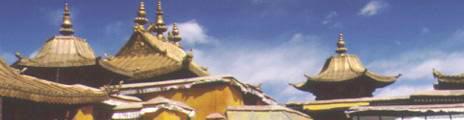
On 13-24 September 2009, four BLSCP members (Bill Warnock, Carol Delker, Stanley Goldberg, Narayan Shrestha) and six others
traveled to Tibet on a tour conducted by Narayan's travel company, Narayan's Travel, Inc. In addition to the sightseeing, some of
the group conducted several sister city activities, including meetings with the mayor of Lhasa and several institutions and bureaus
to identify and discuss topics for future exchanges:
LHASA CITY HOSPITAL
The hospital leaders requested exchanges on these topics:
1. Training on diagnosis and treatment of echinococcosis
2. Provision of an Intensive Care Unit (ICU) and training for its use
3. Receipt of American medical interns, for 30-day exchanges
4. Receipt of American medical teams, for provision of clinical health care in rural Lhasa Prefecture
The Gamow Bag is a portable hyperbaric chamber, which is very effective for lessening the symptoms of Acute Mountain Sickness.
In 1990 BLSCP donated a Gamow Bag to Lhasa City Hospital. For 2009 Narayan Shrestha donated a second Gamow Bag to BLSCP,
which donated it to Lhasa City Hospital during our meeting with the hospital leaders.
LHASA MUNICIPAL HEALTH BUREAU
Some education work has been performed in rural Lhasa Prefecture over the past several years to try to change some habits and
customs, e.g., drinking bad water, eating uncooked meats, and no handwashing after toilet usage. The bureau believes that these
poor health practices are contributing to the spread of echinococcosis. (This is an example of extensive misinformation about the
transmission cycle of echinococcosis.) The bureau believes that technical training on echinococcosis will be an excellent exchange
topic.
LHASA MUNICIPAL EDUCATION BUREAU
The bureau sees great potential for annual exchanges with Boulder on management of schools, teaching methods, and curriculum
research and development. The bureau suggested that each side send school managers (administrators and principals), teachers, and
students to its sister city for a variety of discussions, consultations, and activities. The teachers could observe several actual lessons
and then discuss curricula and teaching methods. The students could participate in actual lessons, after-school student activities, and
perhaps weekend student activities.
The bureau suggested that the best times for Lhasa students to visit Boulder will be mid-January to late February, and we suggested that
the best times for Boulder students to visit Lhasa will be late May to mid-July. Lhasa managers and teachers could visit Boulder at any
time. We agreed that each visit could be for about ten days.
LHASA MUNICIPAL AGRICULTURE AND ANIMAL HUSBANDRY BUREAU
The leading topics for future exchanges were technical assistance from BLSCP for developing a barley soft drink, developing a higher
concentration for beta-glucan capsules of barley nutrients (barley deep process), and improving installation methods for generating
methane (fire-damp) for home cooking gas. Other potential exchange topics include storage for vegetables and fruits, new vegetable
seeds, growing different kinds of flowers, growing more plants for producing traditional Tibetan medicines, and a Lhasa delegation to
Boulder for management training.
LHASA MUNICIPAL ENVIRONMENTAL PROTECTION BUREAU
The bureau sees great potential for cooperation with BLSCP and welcomes exchanges that emphasize new technology and new
ideas. The two leading topics for near-term exchanges are:
1. Advanced urban garbage disposal - Lhasa currently uses landfills and recycling for disposal of its garbage. However, Lhasa is very
interested in using its garbage to generate electricity.
2. Reduction of emissions in the transportation sector - The current issue is how to reduce emissions in the transportation sector,
especially big trucks. The bureau has tried some techniques, e.g., additional engine parts and increasing the air/fuel ratio. However,
difficulties have been experienced.
LHASA MUNICIPAL SCIENCE AND TECHNOLOGY BUREAU
The bureau reported that the BLSCP Solar Electricity project in 1998-2000, which electrified 200 rural homes in Lhasa Prefecture,
provided the bureau with a valuable demonstration and guidance for other areas. Our concept of 20 watts per home was later
extended to other counties in Lhasa Prefecture and to other prefectures in the TAR. Whereas 70% of the families in rural Lhasa
Prefecture did not have electricity in 1998, now only about 5% do not have electricity. Many of the homes are now powered by the
extended power grid or mini-hydro. The rural living standards are higher now, and each family now needs more than 20 watts.
The bureau described four leading topics for near-term exchanges:
1. Solar-powered space heating
2. Solar-powered space cooling
3. Solar-powered water pumping for remote areas without access to the power grid
4. Exchange of experts and technicians
CLOTHING DONATION FOR RURAL TIBETANS
Through donations from private American corporations, BLSCP member Narayan Shrestha has received a large number of
cotton-blend socks (mostly for adults and secondary school students) and clothing items (e.g., colorful T-shirts) for young children
2 to 6 years old). Narayan arranged for all ten members of our group to carry a duffel bag of socks or T-shirts to Lhasa. After a
sightseeing trip to Namtso, our group drove to Gongtang Township in Damshung County and donated about 1000 pairs of socks
and over 100 T-shirts to rural Tibetan families.
SISTER CITY EXCHANGE DEVELOPMENT TEAMS
BLSCP is now forming an Exchange Development Team for each of six program areas: health care, education, environmental
protection, science & technology, agriculture & animal husbandry, and culture & art. The Exchange Development Teams will need
to identify the human and financial resources required to implement the most effective exchanges for helping Tibetans in Tibet.