Boulder-Lhasa Sister City Project (BLSCP) is a non-profit 501(c)(3) public charity formed in 1986
in Boulder, Colorado, which develops and implements non-political exchanges of mutual benefit with Lhasa, Tibet, including
surrounding areas, in health care, education, environmental protection, science & technology, agriculture & animal husbandry, and
culture & art. Boulder is Tibet's only sister city in the United States. Lhasa is
one of Boulder's
ten official sister cities, authorized by the Boulder City Council. |
 |
President Eisenhower promoted a people-to-people initiative in 1956 to involve individuals in citizen
diplomacy, with the hope that personal relationships, fostered through sister city, county, and state affiliations, would lessen
the chance of future world conflicts. Sister Cities International (SCI) is a nonprofit citizen
diplomacy network that creates and strengthens partnerships between U.S. and international communities. SCI promotes peace
through mutual respect, understanding, and cooperation. SCI currently represents more than 2,000 partner cities in more than 140 countries around the
world. Boulder is a member of SCI. |
 |
We invite you to explore our website and contact us for further information. BLSCP is helping
Tibetans in Tibet through programs in Health Care. They will
deeply appreciate your support through donations for our programs or for general use. If you are
qualified, interested, and available, you may be able to participate directly in the development, fundraising, and
implementation of our programs. |
|
History of Major Achievements |
|
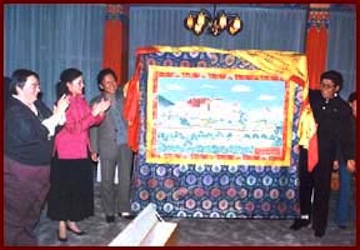
In March-April 1987, Linda Jourgensen, then Mayor of Boulder, led a delegation of about thirty Boulder citizens
to Lhasa to establish the sister city relationship. An affiliation agreement was signed by Mayor Jourgensen and Luo Ga, then Mayor of
Lhasa. As a gift from the people of Lhasa to the people of Boulder, Mayor Luo Ga presented a thangka (scroll painting) of the Potala
Palace to the Boulder delegation. In this photo, Mayor Luo Ga (third from left) presents the thangka to Mayor Jourgensen (second from
left) and Tania Leontov (first from left), then BLSCP President. In September-October 1987, BLSCP hosted Mayor Luo Ga and twelve
other Lhasa delegates in Boulder. |
 |
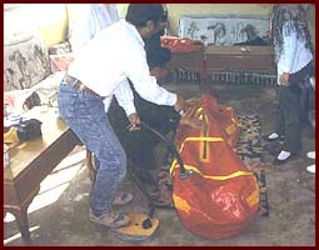 |
In October 1990, Bill Warnock, BLSCP member, visited Lhasa for two weeks to develop several topics
for sister city exchanges. As a gift from BLSCP, he presented Lhasa City Hospital with a Gamow Bag, which is a portable
hyperbaric chamber for treating Acute Mountain Sickness, a common form of altitude illness. The altitude of Lhasa is
3,650 meters (12,000 feet). Narayan Shrestha, a Boulder area resident, joined Bill in Lhasa to demonstrate the Gamow Bag
to the hospital medical staff. In this photo, Narayan is using a foot pump to inflate the Gamow Bag. |
|
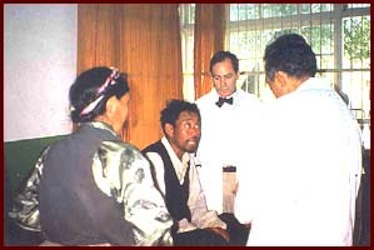
In June 1991, Bill Warnock and Susie Bell, BLSCP members, led a health care delegation to Lhasa City
Hospital for an 11-day skill exchange with the medical staff. The other participants were Dr. Leonard Schwartzman, internist from
Los Angeles; Dr. Ross Brechner, ophthalmologist from Atlanta; and Dr. Howard Hoffman, dentist from Los Angeles. They consulted
on the most common diseases in their specialties and also examined several patients. In this photo, Dr. Schwartzman
(second from right) examines a Tibetan man (third from right) with severe hypertension. |
 |
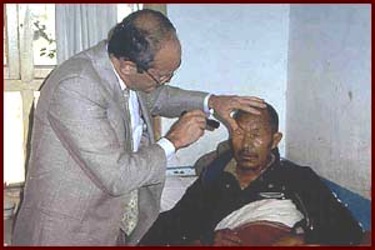 |
In August 1992, Bill Warnock, Susie Bell, and JoAnn Dufty, BLSCP members, led a health care delegation
to Lhasa City Hospital for a one-week skill exchange with the medical staff. The other participants were seven physicians, two
nurses, and a public health specialist. They formed teams for exchanges in ophthalmology, obstetrics/pediatrics, and
hypertension. Also representing ORBIS, the ophthalmology team successfully performed
the first artificial-lens-implant cataract surgery in Tibet. The surgeon was Dr. Ross Brechner. In this photo, Dr. Brechner examines
another Tibetan patient. |
|
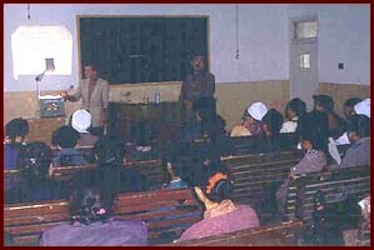
In September 1993, Bill Warnock, BLSCP member, led a health care delegation to Lhasa City Hospital
for a two-week skill exchange with the medical staff. The other participants were Dr. Nancy Harris, internal medicine, from
California; and Dr. John Rosenberg, emergency medicine, from California. They consulted on diseases in their specialties, including
hypertension, heart disease, abdominal cancer, and leukemia; and heart attacks and trauma. In this photo, Dr. Harris (left) lectures
on HIV/AIDS at the regular Tuesday afternoon seminar. |
 |
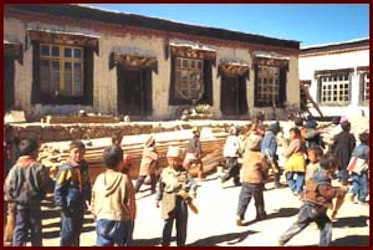 |
In July 1994, BLSCP became a sponsor for Namling County Schools Project, which was founded in 1991
by the late Tashi Tsering, project director, to fight illiteracy in his home county in Tibet. The project built 53 simple primary schools in
rural Tibetan villages. In this photo, students gather at one of the schools. The project also built a vocational
training school for young adults. |
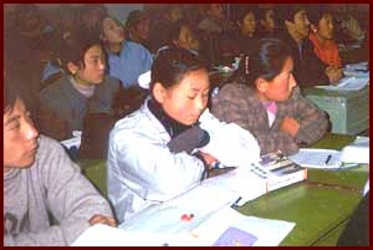
In February 1995, BLSCP became a sponsor for Lhasa Kungshon Language School, which was
established in 1988 by Lhobsang Pandan, school principal. The school provides young adults, mostly Tibetans, with language
and computer classes, as shown in this photo. Students learn skills which help them to qualify for better
jobs. Click here for more information on
Lhasa Kungshon Language School. Scholarships for training in language, computer, and vocational skills would be especially
helpful at this time. |
 |
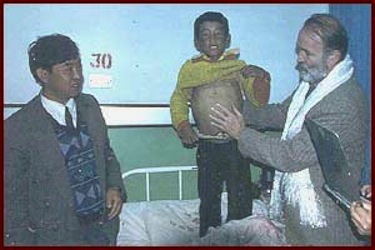 |
In October 1996, Bill Warnock and Carol Delker, BLSCP members, led a delegation to Lhasa for a
one-week exchange with the Ministry of Health of the Tibet Autonomous Region. The other participants were Dr. Peter Schantz,
Centers for Disease Control and Prevention, Atlanta; and Dr. Liu Feng Jie, National Hydatid Disease Centre of China, Urumqi,
Xinjiang. The delegation discussed potential collaboration on echinococcosis, a deadly parasite disease. In this photo at Lhasa
City Hospital, Dr. Schantz examines a boy infected with the
parasite. Click here for current information on the BLSCP Parasite Medical
Program. |
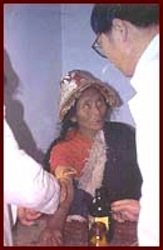
In Summer 1997, Carol Delker, BLSCP member, assisted a renowned medical research team for several weeks in
remote Tibetan villages in northwest Sichuan and southeast Qinghai. Centers for Disease Control and Prevention (CDC), Atlanta, Georgia was the lead institution. They conducted a systematic survey of echinococcosis, a deadly parasite disease, in human and animal
populations. A total of 7,702 Tibetans were tested for the disease. The average infection rate was measured
to be 5.6%. Click here for a report on this research. In this photo, a woman
gives a blood sample for testing. |
 |
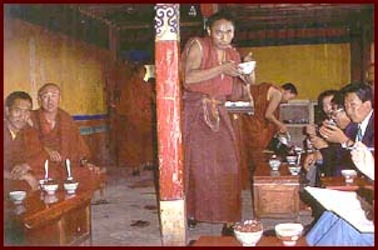 |
In July 1998, Bill Warnock, BLSCP member, led a delegation to Lhasa for a one-week exchange with
Lhasa Science and Technology Commission. The other participants were Andre van Rest, U.S. Department of Energy,
Washington, DC; and Dr. David Renne, National Renewable Energy Laboratory, Golden, Colorado. The delegation visited
many rural areas and discussed collaboration. In this photo, monks at Kangmar Monastery in Damshung County greet the
delegation with droma, a root vegetable, and Tibetan tea, made with butter from dri, the female
yak. |
|
In June-July 1999, Bill Warnock, BLSCP member, led a delegation to Lhasa for a one-week solar
electricity exchange with Lhasa Science and Technology Commission. The other participants were Dr. David Renne, National
Renewable Energy Laboratory; Heshey Phunjok, Wisdom Light Group; Jeevan Goff, Lotus Energy; Simon Tan, Siemens Showa
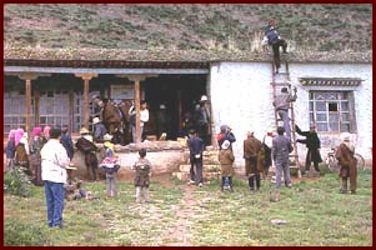
Solar; and Cliff Grassmick, BLSCP member. They installed three small solar electric systems in rural areas, including one at the
Drongkar Community Center, shown in this photo. They also negotiated a workplan for future home installations. |
 |
 |
In April 2000, Wisdom Light Group installed solar electric systems for 100 families in Drongkar
village, Damshung County. In May 2000, Lotus Energy installed solar electric systems for 50 families in Nyari Kuk
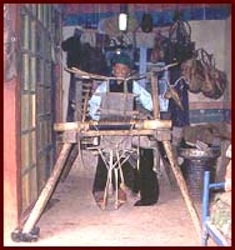
village, Lhundrup County, and 50 families in Lhenpa village, Lhundrup County. In this photo, a woman in Nyari Kuk village
uses solar electricity to weave products to sell for additional family income. In July 2000, Bill Warnock, BLSCP member, visited
Lhasa for two weeks to assess the 200 home installations and gather data for future solar electricity installations. |
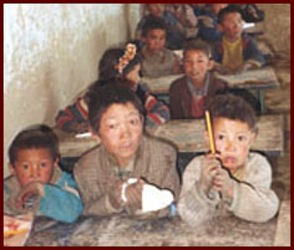
In November 2000, Colette Smith, BLSCP member, visited Lhasa for two weeks to assess the current
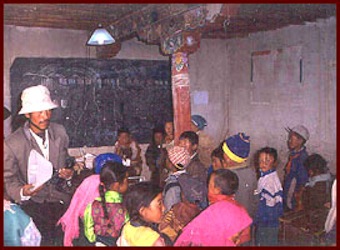
needs of two school programs, for which BLSCP has been a sponsor for several years. Namling County Schools Project built rural schools for primary students, as shown in this photo, and a rural vocational training school for young
adults. Lhasa Kungshon Language School provides young adults with language and computer
classes. Click here for a list of items currently needed by Lhasa Kungshon
Language School. |
 |
 |
In September 2002, Bill Warnock, BLSCP member, led a one-week information exchange with Lhasa
City Hospital on echinococcosis, a deadly parasite disease. The other delegate was Prof. Philip S. Craig, University of
Salford, United Kingdom, a renowned expert on the disease. They discussed the disease with many health care personnel in
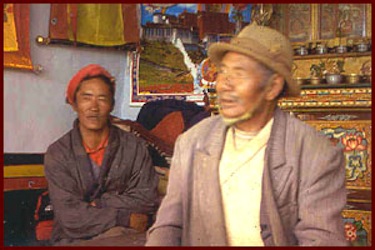
Lhasa Prefecture. In this photo, the delegation meets with a local patriarch (right) and the veterinarian (left) in a village in
Damshung County. Click here for more information on the BLSCP Parasite
Medical Program. |
|
In September 2002, Bill Warnock, BLSCP member, conducted an exchange with Lhasa Science and
Technology Commission on solar electricity installations in Drongkar village, Damshung County. They delivered photovoltaic
equipment and lighting to a medical clinic, four primary schools, four community activity centers, a monastery, and 13
homes. In this photo, a primary school receives solar-powered
lighting. |
 |
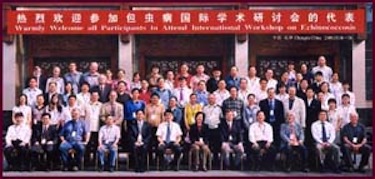 |
In May 2006, Bill Warnock, BLSCP member, attended an International Workshop on "Treatment, Prevention
and Control of Echinococcosis" in Chengdu, Sichuan, China. The workshop participants, shown in this photo, included parasitologists,
epidemiologists, physicians, community health specialists, veterinarians, ecologists, socio-economists, public health experts,
administrators, and other researchers from China and eight foreign countries. Bill presented a 30-minute talk on BLSCP and
its work on echinococcosis. |
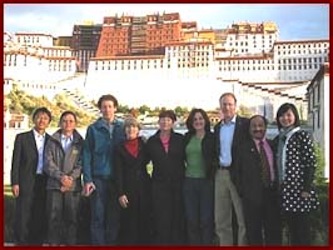
In October 2008, Shaun McGrath, then Mayor of Boulder, led a delegation of six to Lhasa to strengthen the
Boulder-Lhasa sister city relationship. In this photo, the delegation and three of the Lhasa hosts are at the Potala Palace: Jigmi Drapa,
interpreter; Cao Bianjiang, Executive Deputy Mayor, Lhasa Municipality; Bill Warnock, BLSCP President; Suzy Ageton, Boulder City
Councilmember and Council Liaison to BLSCP; Carol Delker, BLSCP Vice President; Becca Heaton, Editor, Rocky Mountain Sports;
Shaun McGrath; Narayan Shrestha, BLSCP member; Pema Droka, interpreter (left to right). Click here to view a Memorandum of Agreement on Strengthening of the Sister City Relationship (PDF) signed by Mayor McGrath. |
 |
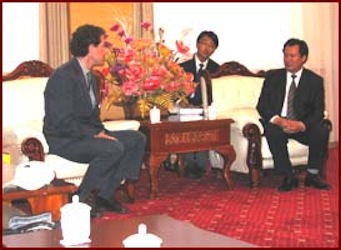 |
In September 2009, four BLSCP members and six others traveled to Tibet on a tour conducted by Narayan's
Travel, Inc. In addition to the sightseeing, some of the group conducted several sister city activities. In this photo, BLSCP President
Bill Warnock (left) demonstrates citizen diplomacy during a discussion of the Boulder-Lhasa relationship with Lhasa Mayor Dorji
Tsedrup (right), with language interpretation by Jigmi Drapa, Lhasa Foreign Affairs Office (center). |
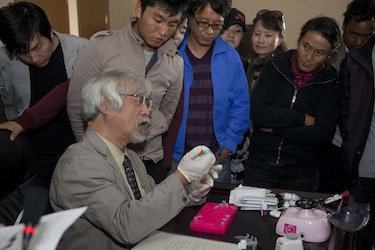
In September 2010, BLSCP members Bill Warnock, Carol Delker, and Megan Newton led a 7-day training exchange in Lhasa Prefecture with Lhasa Municipal Health Bureau on "Diagnosis and Treatment of Echinococcosis." BLSCP's five expert trainers provided several lectures and demonstrations regarding this deadly parasite disease, which is causing extensive suffering by rural Tibetans in Lhasa Prefecture and elsewhere on the Tibetan Plateau. In this photo, Prof. Akira Ito is demonstrating the use of a rapid diagnosis kit to Lhasa health care providers. Click here to view our complete trip report with 12 photos (PDF). |
 |
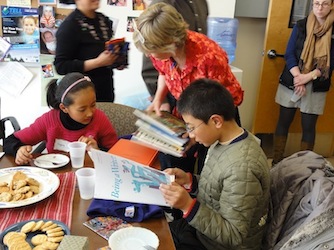 |
In February 2011, BLSCP hosted an education exchange in Boulder with a delegation from Lhasa Municipal Education Bureau. Three administrators, two sixth-grade students, and an interpreter visited five Boulder-area middle and elementary schools and the University of Colorado School of Education. They consulted on school management, teaching methods, and curriculum research and development. In this photo, Peyang and Luoluo are receiving books from Whittier International Elementary School. Click here to view our exchange report with 16 photos (PDF). |
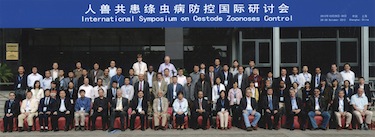
In October 2012, Bill Warnock, BLSCP member, attended an International Symposium on Cestode Zoonoses Control in Shanghai, China. Cestode zoonoses are tapeworm diseases that can be passed from animals, whether wild or domesticated, to humans. The symposium was attended by 96 participants from 13 countries, Chinese Ministry of Health, and World Health Organization. Bill was the only participant from the U.S.A. He made a presentation on "Echinococcosis Training in Tibet", which describes the BLSCP training exchange conducted in Lhasa during September 2010. Click here for more information on the BLSCP Parasite Medical Program. |
 |
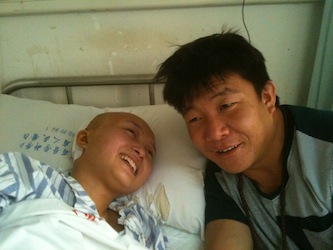 |
In August-September 2013, BLSCP member Bill Warnock arranged and managed brain surgery for Lhungtse, a teen-age Tibetan girl who was suffering from a parasitic disease called neurocysticercosis. The successful surgery was performed on September 5 at Sichuan Provincial People’s Hospital in Chengdu. In this photo, Lhungtse is chatting with interpreter Delek during her recovery. Click here to view our report on Lhungtse's surgery with 8 photos (PDF). |
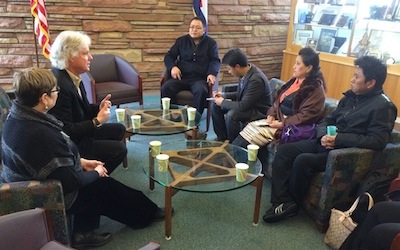
On 10-13 November 2014, Madam Tsering Yangzom, Deputy
Mayor of Lhasa, led a Lhasa delegation of six to Boulder for a reciprocal
mayoral exchange. In this photo, Boulder Mayor Matthew Appelbaum explains his perspectives
on the Boulder-Lhasa sister city relationship: Ms. Alisa Lewis,
Boulder City Clerk; Mayor Appelbaum; Mr. Danzengquzha, General Director of Lhasa Tourism Bureau; Mr.
Jigmi Drapa, Interpreter of Lhasa Foreign Affairs Office; Deputy Mayor Tsering Yangzom; Mr. Jianghua, General Secretary of Lhasa Municipal Government (left to right). Click here to view our exchange report with 4 photos (PDF). |
 |
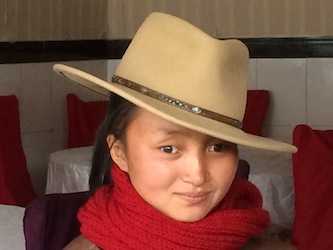 |
On 30 April-5 May 2015, BLSCP members Bill Warnock and Shari Mayer traveled to Kangding, Sichuan, to visit Lhungtse, the blind Tibetan girl for whom BLSCP provided brain surgery in 2013. After meeting with two of her doctors in Chengdu, they visited her at Ganzi Prefecture Special School and had some weekend fun in the village of Tagong in Kham. Then they met again with her neurologist in Chengdu to discuss her recovery and medication. In this photo, Lhungtse is enjoying lunch in Tagong. Click here to view our trip report with 6 photos (PDF). |
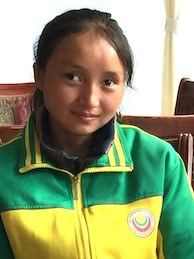
On 12-17 November 2015, BLSCP members Bill Warnock and Shari Mayer traveled again to Kangding, Sichuan, to visit Lhungtse, the blind Tibetan girl for whom BLSCP provided brain surgery in 2013. After Bill met with two of her doctors in Chengdu, they visited her at Ganzi Prefecture Special School. They had beneficial discussions with her mother, Headmaster, and head teacher. In this photo, Lhungtse is enjoying lunch in Kangding. Click here to view our trip report with 4 photos (PDF). |
 |
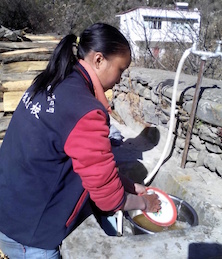 |
On 30 October-7 November 2016, BLSCP members Bill Warnock and Shari Mayer traveled to Chengdu, Sichuan, to take Lhungtse to her neurologist, Dr. Zeng Xian Rong, for an examination and tests. She is the blind Tibetan girl for whom BLSCP provided brain surgery in 2013. Because she had suffered from a larger number of epileptic seizures this year, Dr. Zeng prescribed a second medicine for her. Then they returned Lhungtse and her mother to their home in Yajiang. In this photo, Lhungtse is washing some dishes at her home. Click here to view our trip report with 4 photos (PDF).
|
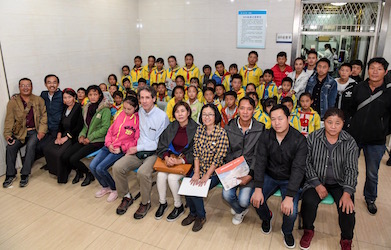
On 21 October 2017, BLSCP conducted the Shuiluo Student MRI Project in Xichang, Sichuan. MRI brain scans performed for 44 students and 3 adults revealed 11 cases of neurocysticercosis. Dr. Li Tiaoying hopes that 10 of these patients can be cured with appropriate drug therapy. The other patient is Lhosang Drolkar, a 19-year-old Tibetan woman from Muli County, Donglang Township, whose MRI showed many cysts and severe hydrocephalus. Her symptoms indicated an urgent need for brain surgery. BLSCP contributed a Shuiluo Student MRI Project surplus of $9,707 as a major percentage of the cost of this surgery, which was successfully performed in Chengdu on November 6. Click here to view our trip report with 15 photos (PDF). |
 |
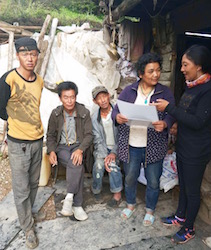 |
On 4-6 September 2018, in collaboration with Dr. Li Tiaoying, Sichuan CDC, we conducted a 3-day pilot training project for rural Tibetan doctors in Shuiluo Township, Muli County, on prevention of neurocysticercosis (NCC). NCC is a dangerous parasitic disease that is highly prevalent in 24 counties in western and southern Sichuan Province of China (Kham). Click here to view our report on this work, with 7 photos and cost data. In this photo Dr. Tsering Yangzom, medical doctor, Dongla Village, Shuiluo Township, is educating local residents about NCC with the two laminated photo sheets that she received at the training in Xichang.
|
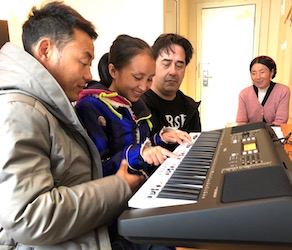
On 22-30 October 2018, BLSCP members Bill Warnock and Shari Mayer were joined by Aaron Miller (Bill’s nephew) on a trip to Chengdu and Kham to spend time with Lhungtse and her mother. After we learned in 2017 that Lhungtse loves the piano, Bill invited Aaron to join us on this trip and offer keyboard lessons to Lhungtse. Aaron is a full-time keyboard instructor in Bend, Oregon. Click here to view our report on this work, with 5 photos and cost data. In this photo our guide Tenpa is interpreting Aaron’s instruction from English into Lhungtse’s local Tibetan dialect, with Lhungtse’s mother observing. |
 |
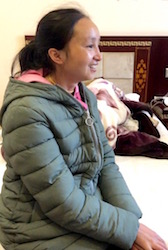 |
In late October 2019, BLSCP member Bill Warnock traveled to Chengdu to spend several days with Lhungtse and her mother. We arranged for Lhungtse her annual medical checkup and a keyboard lesson. Click here to view our report on this work, with 4 photos and cost data.
|
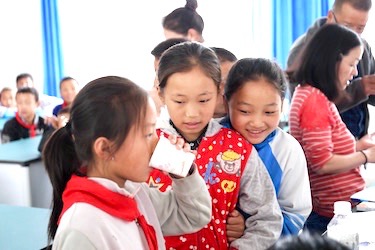
Taeniasis refers to the parasitic infection of adult stages (tapeworms) of three Taenia species. Roundworm and whipworm are soil-transmitted parasitic infections. These five parasitic diseases are highly prevalent in southwestern Muli County, Sichuan Province, China (Kham). During June-December 2019, our partner, Dr. Li Tiaoying, Sichuan CDC, Chengdu, worked to eliminate these five diseases in 535 Tibetan children attending two primary schools in Muli County. Click here to view final results for this project. |
 |
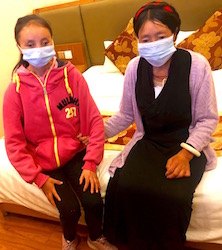 |
On 7-13 October 2020, Tenpa drove Lhungtse & her mother to Chengdu, managed Lhungtse’s medical checkup, bought medicine, and returned them to their home in Kham. To view our report, including photos and a cost breakdown, click here. This photo shows Lhungtse & her mother in their hotel room in Chengdu.
|
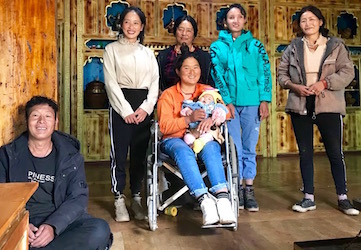
Since October 2017, BLSCP has been helping two daughters of a Tibetan family living in Donglang Township, Muli County, Sichuan Province (Kham). In November 2017, we provided for brain surgery for Lhosang Drolkar. In 2020, we provided for warm clothing for the family and medicine for Tsering Youdon. On 7 November 2020, our partner, Dr. Li Tiaoying, Sichuan CDC, Chengdu, visited the home of the Donglang family and sent me this photo. To view our report, click here. |
 |
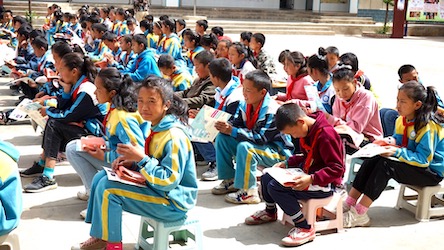 |
On 12-13 May 2021, Dr. Li Tiaoying, Sichuan CDC, and Dr. Duan Mian Chuan, Muli County CDC, trained 340 Yiji Primary School students (1st-6th grade), 13 homeroom teachers, and 30 Yiji Township medical staff members and village cadres (government workers) on taeniasis and neurocysticercosis (NCC). To view our report, including photos and a cost breakdown, click here. This photo shows some of the Tibetan primary school students receiving training on the diseases.
|
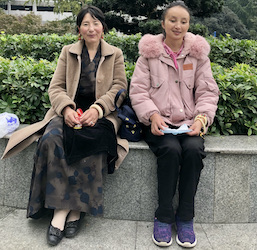
On 17-26 October 2021, Tenpa drove Lhungtse & her mother to Chengdu, managed Lhungtse’s annual medical checkup, bought medicine, and returned them to their home in Kham. To view our report, including photos and a cost breakdown, click here. This photo shows Lhungtse & her mother (Ama la) outside of the hospital in Chengdu. |
 |
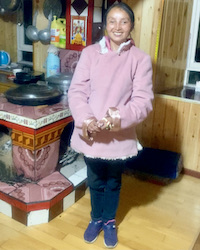 |
On 1-5 November 2022, Tenpa drove Lhungtse & her mother to Chengdu, managed Lhungtse’s medical checkup, bought medicine, and returned them to their home in Kham. To view our report, including photos and a cost breakdown, click here. This photo shows Lhungtse at home, just after returning from Chengdu.
|
During 2022, Dr. Li Tiaoying, Sichuan CDC, Chengdu, and her team trained rural doctors in Muli County, Sichuan Province (Kham) on (1) all aspects of taeniasis and neurocysticercosis (NCC), (2) how to identify taeniasis carriers, (3) how to conduct treatment, including preparation of the herbal medicines, and (4) how to record the results of treatment. To view our final report, click here. |
 |
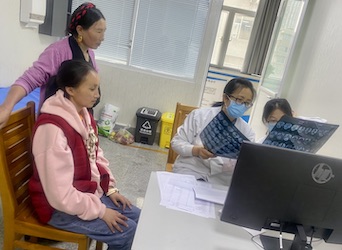 |
On 26-30 October 2023, Tenpa drove Lhungtse & her mother to Chengdu, managed Lhungtse’s medical checkup, bought medicine, and returned them to their home in Kham. To view our report, including photos and a cost breakdown, click here. This photo shows Lhungtse being examined by Dr. Zeng in her office at Sichuan Provincial People's Hospital in Chengdu.
|
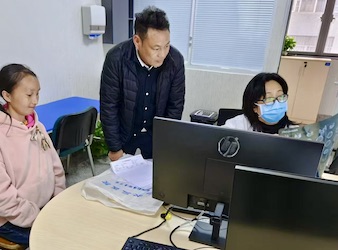
Based upon the success of our 2022 project, the Sichuan Provincial Finance Department for Public Health has appropriated 5 RMB per each Muli County resident to be used in 2023 by rural doctors in the county for the detection and treatment of taeniasis. With the Muli County population being 130,000, the total amount is 650,000 RMB (~100,000 USD). To optimize the use of the 650,000 RMB, more rural doctors needed to be trained to treat taeniasis carriers with the herbal medicines. BLSCP collaborated with Dr. Li Tiaoying, Sichuan CDC, (conducting training in this photo) for a 2023 project to extend our 2022 taeniasis training model to four additional townships in Muli County with high taeniasis infection rates. This project was successfully conducted in mid-April 2023. To view a project description, click here. |
 |
 |
On 14-18 November 2024, Tenpa drove Lhungtse, her mother, & her brother to Chengdu, managed Lhungtse’s medical checkup, bought medicine, and returned them to their home in Kham. To view our report, including photos and a cost breakdown, click here. This photo shows Lhungtse being examined by Dr. Zeng in her office at Sichuan Provincial People's Hospital in Chengdu.
|
On 25-28 July 2025, BLSCP and the City of Boulder welcomed a Lhasa delegation of 15, including 5 government officials and 10 members of the Lhasa Song and Dance Troupe, for a sister city exchange. The highlight of the exchange was a special cultural performance, “Traditional Tibetan Opera, Dances, and Songs”, by the Lhasa Song and Dance Troupe. To view our exchange report, including many photos, click here. This photo shows Dance - Love of Eastern Tibet. |
 |
|